


Why Does Stress Whitening Occur in Thermoformed Sheets?
 Nov 03, 2026|
 View:2
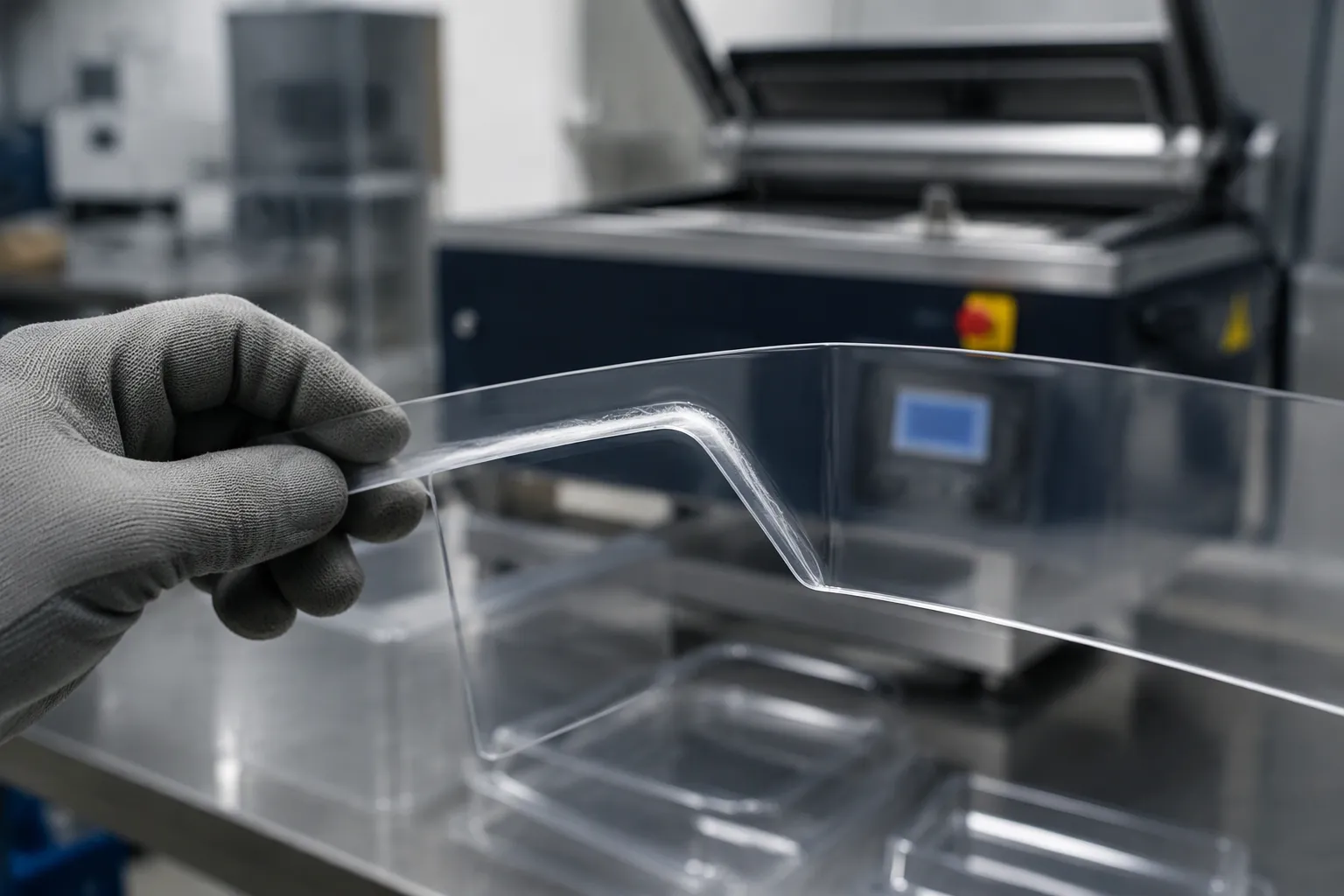
A freshly formed part leaves the mold looking perfect. Then someone folds a corner, and a milky-white streak appears along the bend. That streak is stress whitening, and it shows up on thermoformed sheets when polymer molecules stretch or heat in ways that change how they scatter light. Think of a clear plastic straw. Bend it far enough, and the crease turns white. The same thing happens inside a sheet. Stress whitening has two main triggers: mechanical strain and thermal history. Stress whitening from strain looks different from stress whitening from heat. This post separates the two kinds of stress whitening, then walks through causes, detection, and prevention.
Key Takeaways
Stress whitening shows up as a milky streak when polymer molecules stretch or heat changes how they scatter light.
Mechanical strain and thermal history are the two main causes of stress whitening in thermoformed sheets.
Lab tests like DSC and polarized light can show whether stress or heat caused the whitening.
Pick the right sheet material and control the forming settings to stop stress whitening at folded corners.
Knowing how stress whitening works helps manufacturers predict and prevent defects before products reach customers.
Why Stress Whitening Happens in Thermoformed Sheets
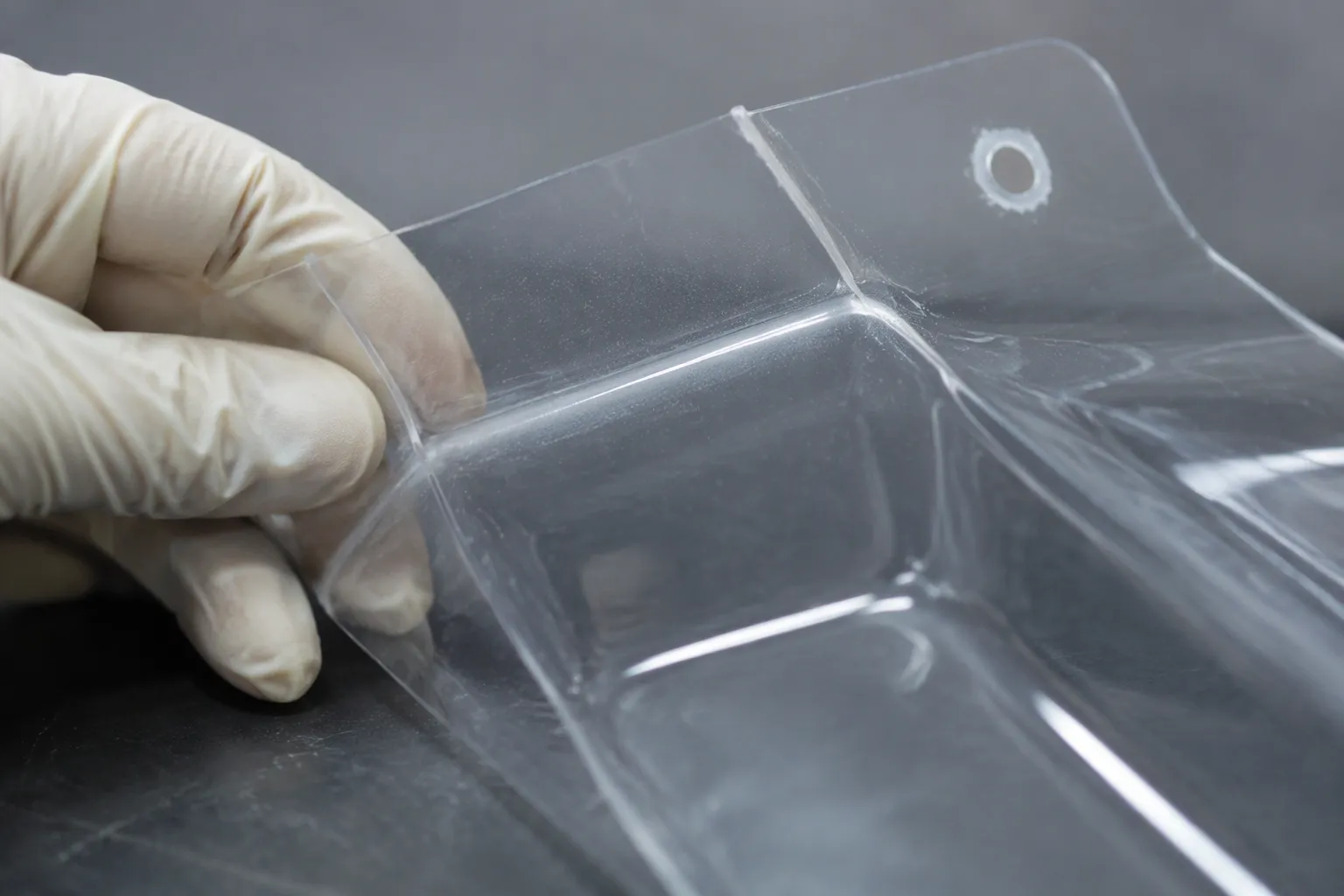
A white line along an edge after cold bending or punching tells a clear story. The same milky streak can show up right after forming. This happens when one area of the sheet was underheated or over-drawn. Both cases look the same on the surface. But the causes behind them are different.
When Polymers Can Get Stressed
Stress-induced whitening starts with mechanical strain. The sheet bends too far, too fast, or too cold. Polymer chains stretch and line up in the strained zone. Tiny voids open between the chains. These microvoids scatter light instead of letting it pass through. The result is the familiar whitened look along a fold or a punched edge.
The straw analogy helps here. A clear straw bends without complaint at first. Push it further, and the crease turns white. The polymer has yielded, and light now bounces off the damaged zone. Thermoformed sheets act the same way when a corner is folded cold. The same thing happens when a plug forces the material past its limit. Strain rate matters as much as strain amount. Fast, cold deformation raises stress-whitening potential sharply. Slow, warm deformation lowers it.
When Heat Changes the Picture
Heat-induced whitening follows a different path. Improper thermal conditioning leaves the sheet either too hot or too cold. Overheating can trigger crystallization in a resin designed to stay amorphous. Crystalline regions scatter light, and the affected area turns milky, white, or hazy. The Pulixin Group notes that this whitening is particularly noticeable in areas exposed to excessive heat or prolonged heating. Localized overheating also raises the risk of degradation and uneven material behavior.
Underheating creates its own problem. A sheet that is not softened enough resists stretching. The forming force then creates too much stress. Stress whitening appears even though heat was the root cause. The Pulixin Group describes the goal as a stable and suitable forming window, not the lowest possible temperature.
The table below summarizes how crystalline morphology affects light behavior, based on Jwell Extruders:
Aspect | Effect on light and whitening |
|---|---|
Fine crystalline morphology | Spherical crystallites below 0.5 μm minimize scattering and preserve transparency even at 28–32% crystallinity |
Amorphous structure | Transmits light with minimal scattering, keeping the sheet clear |
Opacity vs crystallinity | Opacity rises with crystallinity; haze below 3 percent requires an amorphous grade |
Stress whitening in thermoforming | Deep-draw grades with uniform elongation show lower propensity for stress whitening |
This is where whitening occurs in plastic through two routes: chain damage or crystal growth. Both change light scattering, and both deserve separate diagnosis.
Inside the Polymer: Chain Stretching and Light Scattering
Crazing and Micro-Voids
Stretched chains and voids change how light scatters inside a sheet. Wikipedia notes that crazes have a lower refractive index than the material around them, so they scatter light. A dense field of crazes turns a clear sheet opaque. Engtechnica describes the same event: molecular chains stretch and separate, and tiny microvoids bridged by thin fibrils send light in many directions. The eye sees that scattered light as a white or cloudy patch. This is where stress whitening begins.
This mechanism drives stress whitening in semi-crystalline and amorphous polymers alike. Microvoids and microcrazes appear wherever deformation concentrates, and microcrazes and/or microvoids multiply as strain continues. Each void adds a new interface, and light scattering rises with every interface. The result is a whitened look along folds, punched edges, and deep draws. Stress-whitening potential climbs with strain rate and drops as sheet temperature rises. Microvoids near the surface scatter the most, so stress whitening shows first on the outer skin of a bend.
A Note on PP Copolymers
Polypropylene follows a different path. A pp homopolymer is semi-crystalline, and pp copolymers keep a semi-crystalline structure as well. A pp copolymer resin can whiten through crystallization-related scattering, not only through voiding. Stress-whitening potential in pp copolymers therefore depends on thermal history as much as mechanical load. PP copolymers still develop microcrazes under strain, yet crystal growth adds a second route to whitening or blush. Cooling rate shapes crystal size, and finer crystals scatter less light.
Amorphous resins such as ABS and PC/ABS whiten mainly through crazing and voiding. Neither family wins in every case. PP copolymers fit parts where chemical resistance and cost drive the choice, while ABS and PC/ABS suit appearance-critical trim. PP copolymers also hold up in molded housings that see repeated flexing. Matching resin to part geometry keeps stress whitening in check. Controlled heating and gentle draw ratios then hold stress whitening below the visible threshold.
How to Test and Diagnose the Cause
A white streak on a formed part raises one question: did stress or heat produce it? Two lab techniques answer that question with evidence rather than guesswork. Each method targets a different fingerprint of the cause of whitening.
Differential Scanning Calorimetry (DSC)
DSC measures how a small sample absorbs or releases heat as its temperature changes. The test reveals thermal history and crystallinity changes inside the sheet. TA Instruments describes how DSC fingerprints processing history, because processing conditions shape crystallinity and mechanical properties. A lab heats a sample above its melting point, holds it briefly, then cools it at a controlled rate. The heat of crystallization or fusion then gives the crystallinity value. For PET, TA Instruments divides the measured heat by the heat of fusion for 100% crystalline PET, which is 140 J/g. A slow cooling rate of 10 °C/min produces one crystallization profile, while ballistic cooling produces another. A part that whitened from too much heat often shows crystallinity well above the expected baseline. That result confirms heat as the driver and rules out mechanical strain.
Optical Birefringence
Optical birefringence shows leftover molecular orientation. Astra Products explains that internal stress or molecular orientation causes birefringence in plastics, and thermoforming, bending, and mechanical pressure can all introduce it. A clear sheet may look perfect to the eye yet still hold internal stress. Place that sheet between polarizers, and stressed zones appear as colorful bands or bright irregular patterns. Those colors come from polarized light traveling differently through oriented regions. A whitened corner that lights up under polarized light points to stress as the cause. A corner that stays dark points toward thermal history instead.
Pair these methods with impact testing and blush testing on production samples. Impact testing shows how the sheet behaves under sudden load. Blush testing reproduces the fold that started the problem. Together, the four checks separate stress whitening from heat-driven whitening and guide the fix.
How to Prevent Stress Whitening at Folded Corners
Material Selection with Xinhejiu Sheets
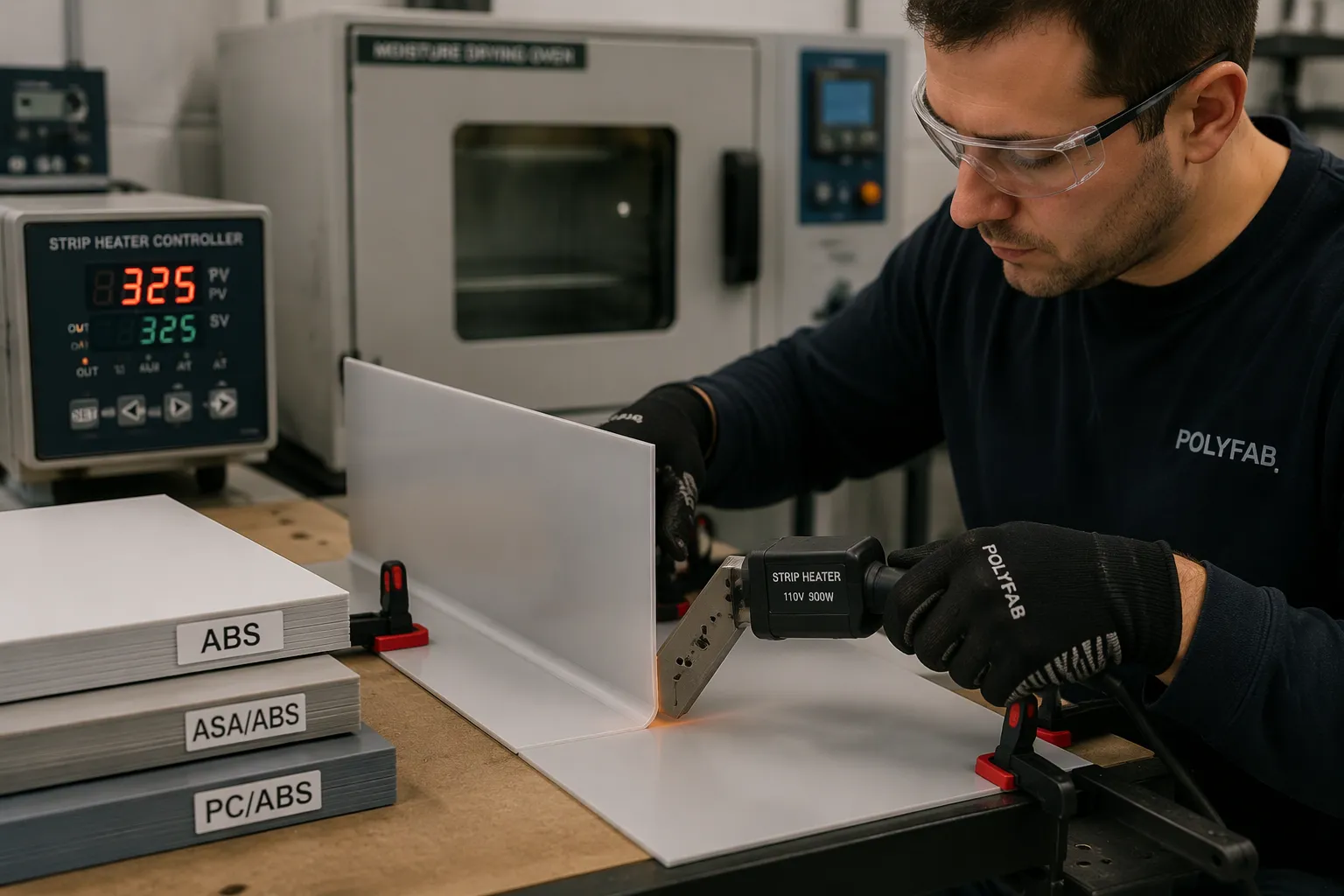
The material you pick sets the starting point for stress whitening at folded corners. XinhejiuABS SHEET works well for general thermoforming and is easy to process. Farcoplastics reports that ABS forms well under vacuum, with a vacuum-forming range of 150 to 180 °C (302 to 356 °F). The same source notes that ABS must be dried first, at 90 minutes per millimeter of thickness. Drying it right keeps moisture from making bubbles that raise stress-whitening potential. A well-mixed color masterbatch also helps light scatter evenly across the sheet. Color masterbatch formulation matters here, because uneven pigment dispersion can hide or copy whitening. Impact testing on production samples shows how each batch handles a sudden load.
Outdoor parts need to keep their surface as well as their toughness. Alpine Mold lists automotive exterior parts, siding, and outdoor electrical housings as ASA applications where long-term durability is critical. MDE Plastics adds building exterior wall panels, roof tiles, and outdoor furniture to that list. Xinhejiu ASA/ABS SHEET puts an ASA outer layer over an ABS substrate, so it combines UV resistance with the impact resistance and thermoformability of ABS. For high-impact and heat-resistant parts such as rail and automotive interiors, Xinhejiu PC/ABS SHEET fits best. Each family has its place, and matching resin to part geometry lowers stress-whitening propensity.
Forming Parameters and Process Control
Process control decides whether a good sheet stays clear at the fold. Preheat and thermal conditioning come first. Eureka Patsnap describes localized heating along the bend line with strip heaters at 90–110 °C for 20–40 seconds, which softens the material to prevent stress whitening or cracking. Even material distribution keeps heat uniform across the sheet. Cold plugs and too much plug speed put strain in one zone, and that zone whitens first. Draw ratios should match sheet toughness, so a deep draw uses a grade built for it. A consistent color masterbatch and a stable color masterbatch formulation help operators spot true whitening against the sheet color. Regular impact testing closes the loop on stress-whitening problems in thermoformed sheets. These steps prevent stress whitening before it reaches the customer.
A white streak on a formed part is a sign from the molecules. Stress whitening points to strain, and heat-driven whitening points to thermal history. Reading that stress whitening signal the right way is the key to prevention. Teams that understand how it works can predict failures before they reach the customer. They stop reacting to stress whitening complaints and start controlling the process.
Sheet quality and forming conditions work as a pair. Look at both together. High-quality composite sheets from Xinhejiu, made to resist whitening at folded corners, help lower defect and complaint rates. The right sheet, formed with the right settings, keeps stress whitening away from folded corners. That mix is how manufacturers prevent stress whitening for good.
FAQ
How can a fabricator tell stress-induced whitening from heat-induced whitening?
Where and when the whitening shows up gives the first clue. A white line along a cold bend or punched edge points to strain. Whitening that appears right after forming points to thermal history. Lab checks confirm the cause. DSC shows crystallinity changes from heat, and polarized light shows leftover orientation from strain.
Can a whitened corner recover its original clarity?
Usually no. The micro-voids and crazes that scatter light stay in the polymer after the load is gone. Some minor blush may fade a little over time. A visible white streak usually stays. Fabricators should treat the streak as a permanent defect and focus on prevention instead of rework.
Which Xinhejiu sheet suits fold-corner parts?
It depends on the application. ABS SHEET covers general thermoforming with balanced processability. ASA/ABS SHEET adds weather resistance for outdoor parts. PC/ABS SHEET fits high-impact, heat-resistant components such as rail and automotive interiors. Matching the resin to the part geometry lowers the risk of stress whitening at folds.
Does drying the sheet before forming matter?
Yes. Moisture in the sheet can bubble during heating, and bubbles raise the chance of stress whitening. ABS needs drying before forming. A dry sheet heats evenly and stretches predictably. Even heating supports a stable forming window and keeps folded corners clear.
Why do cold plugs make whitening worse?
A cold plug forces the sheet to stretch before it softens. Strain builds up in one zone, and that zone whitens first. Warm plugs and moderate plug speed spread the draw across the part. Even material distribution and draw ratios matched to sheet toughness complete the fix.