


Which Composite Plastic Sheet is Best for Vacuum Forming
 Oct 13, 2026|
 View:
Buyers early in sourcing usually need a sheet with good melt flow, predictable draw behavior, and strong cost-performance. That need naturally points toward PMMA/ABS-type materials. Market data supports this lean: ABS holds 40% of vacuum forming material share, ahead of polycarbonate at 35%, polystyrene at 15%, and polyethylene at 10%.
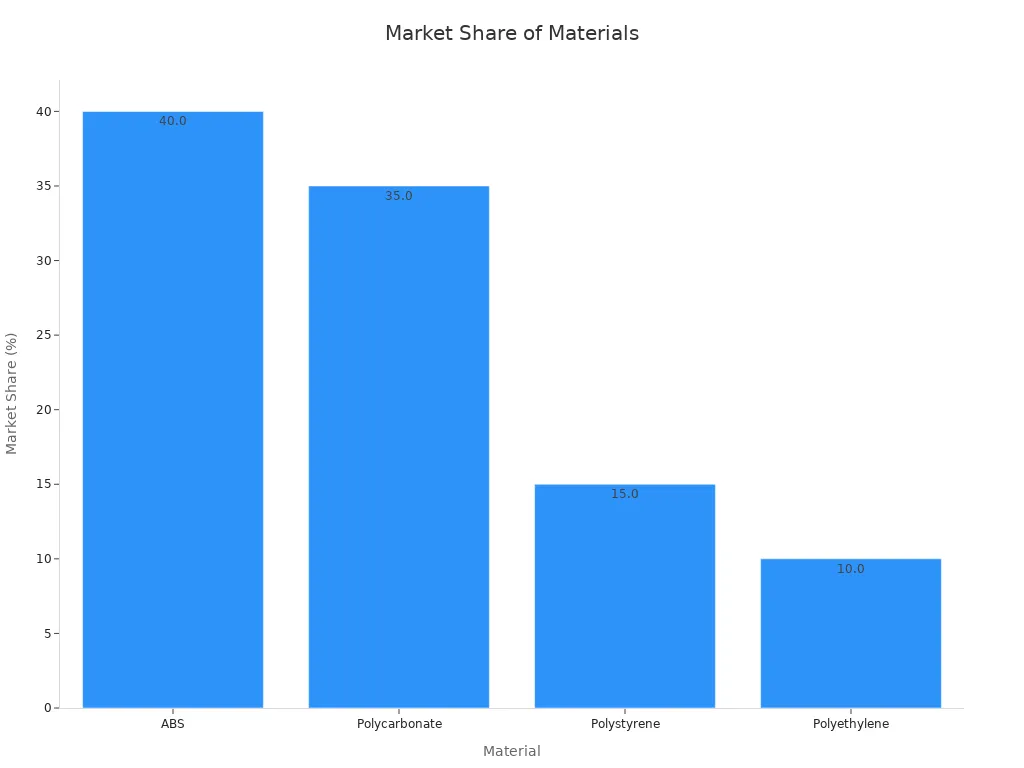
This comparison of each composite plastic sheet option shows how to match a material to a specific part, volume, and budget.
Key Takeaways
ABS is the best all-around plastic sheet for vacuum forming because it is strong, easy to shape, and does not cost much.
PMMA/ABS gives a shiny, scratch-resistant surface for products that need a high-end look.
Pick the right sheet for the task: ABS for everyday parts, ASA/ABS for outdoor use, PC/ABS for high heat, and PETG for clear packaging.
Before you buy, check that the sheet meets safety rules like UL94 V-0 for fire resistance and RoHS/REACH for environmental safety.
Keep costs down by planning your cuts carefully. Also ask for free samples so you can test finishes and colors.
The Best Composite Plastic Sheet, Answered
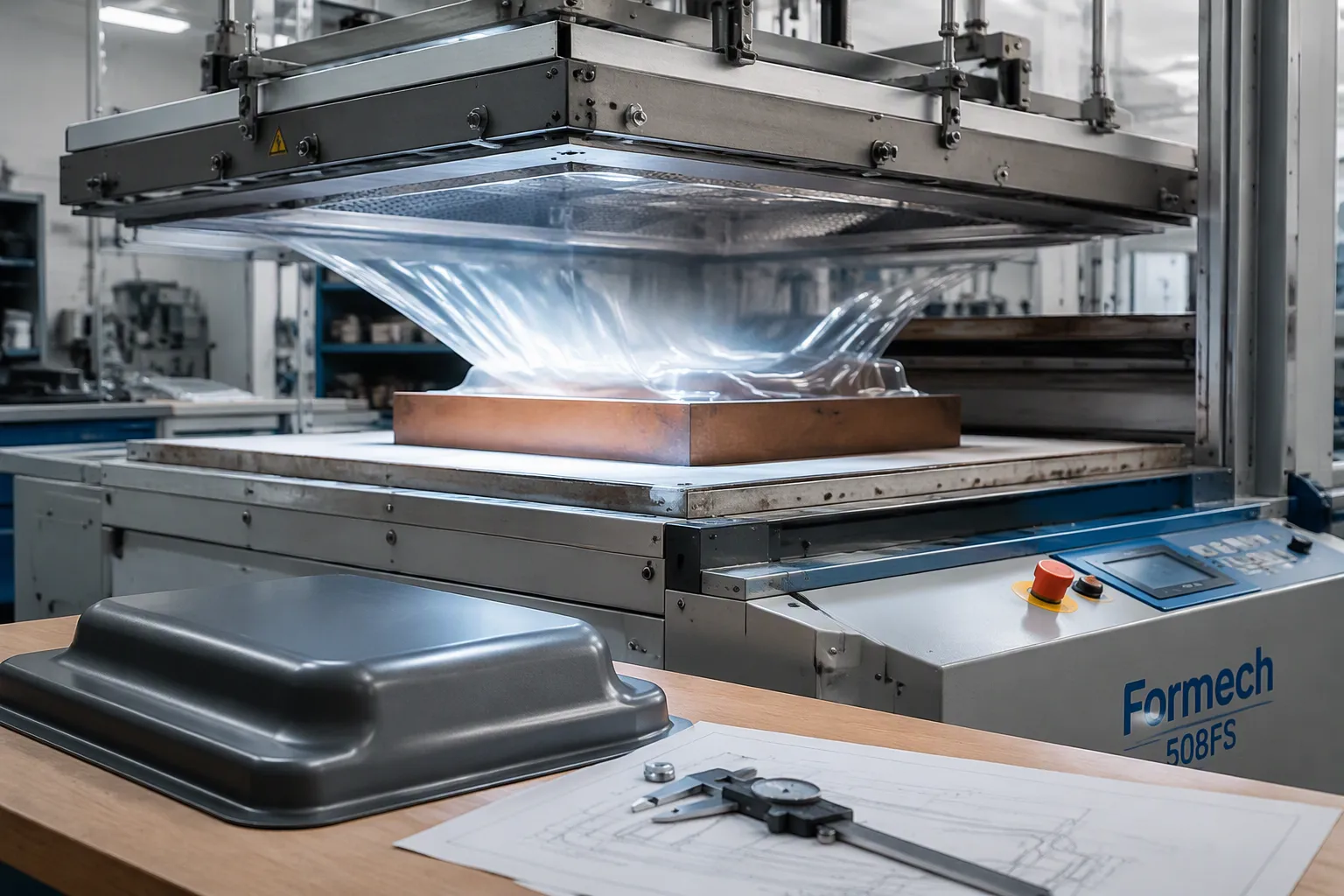
ABS is the best overall composite plastic sheet for vacuum forming in most projects. PMMA/ABS, also called acrylic-capped ABS, is the premium finish option when a part needs a mirror-like gloss and strong scratch resistance. This answer works for general-purpose jobs. A part with unusual heat, clarity, or chemical needs may point to a different material, and the sections below show where each material fits best.
Why ABS Leads
ABS earns this spot through four practical strengths. It flows well when heated, so the sheet pulls evenly over a mold without thin spots. It stretches easily, which suits deep draws and complex shapes. It holds its shape after cooling, which keeps finished parts consistent. It also gives strong cost-performance, so buyers get reliable results without a premium price.
The property profile explains the fit. ABS offers high impact resistance and toughness, resists acids, alkalis, and oils, and thermoforms easily into complex shapes. A smooth surface accepts paint, plating, or texturing. The material stays strong and rigid while remaining lightweight.
Dimensional stability sets ABS apart from many alternatives. The sheet shows low shrinkage and keeps its shape under stress. Controlled cooling after the sheet conforms to the mold prevents warping. ABS also stays stable throughout the forming process, which supports uniform parts where tight tolerances matter. One caution applies to fixed installations: the coefficient of thermal expansion is about 5.0 × 10⁻⁵ in/in/°F. A 96-inch sheet therefore expands roughly 0.24 inch over a 50 °F swing, so the design must allow for that movement.
Property | Description | Relevance to Vacuum Forming |
|---|---|---|
Durability | High impact resistance and toughness | Suitable for products needing strength and longevity |
Chemical Resistance | Resists acids, alkalis, and oils | Enables use in various industrial applications |
Thermoformability | Easily thermoformed | Allows production of complex shapes and designs |
Surface Finish | Smooth finish, easily painted, plated, or textured | Supports aesthetic and functional finishing options |
Lightweight | Strong and rigid yet low in weight | Ideal where weight is a concern |
Forming temperatures stay manageable. ABS runs in a vacuum-forming range of 150–180 °C (302–356 °F) and needs pre-drying, a routine step that protects surface quality.
Six Selection Criteria
Buyers should weigh six criteria before committing to a sheet.
Formability covers melt flow and stretch behavior. A sheet that draws evenly cuts scrap and rework.
Strength matters for parts that face impact or load. Impact resistance and stiffness set the limit on how thin a wall can go.
Temperature resistance defines the service environment. A part near heat sources needs a sheet that holds its shape under steady warmth.
Surface finish decides how much post-processing the part requires. Smooth, matte, and textured options each suit different end uses.
Compliance governs market access. Flame retardancy and environmental standards can rule out a material before cost enters the discussion.
Cost closes the loop. Material price, scrap rate, and finishing steps together set the real expense per part.
ABS is the default starting point, not the only choice. Each criterion above helps a buyer confirm that default or move toward a better fit.
Comparing Composite Plastic Sheet Options
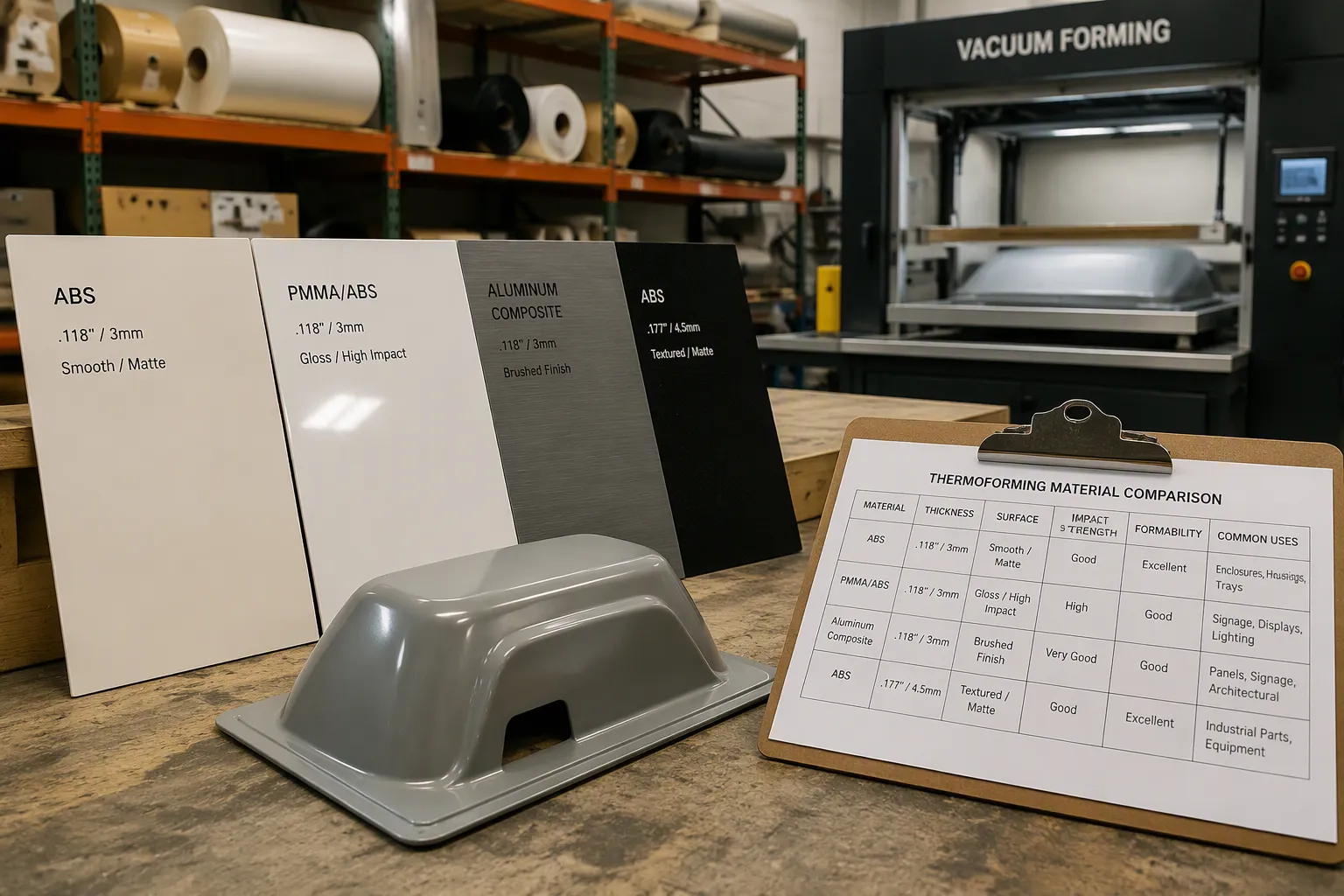
Comparison Table
The table below rates each material family on the six criteria from the previous section. The ratings are qualitative, because exact values vary by grade and supplier.
Material | Formability | Strength | Temperature Resistance | Finish | Compliance | Cost |
|---|---|---|---|---|---|---|
ABS | Excellent | High impact | Moderate | Smooth, matte, textured | UL94 V-0 available (FR grades) | Low to moderate |
PMMA/ABS | Excellent | Good impact | Moderate | Mirror gloss, scratch resistant | RoHS compliant | Moderate |
ASA/ABS | Excellent | Good impact | Moderate, UV stable | High gloss, weather resistant | RoHS and REACH compliant | Moderate |
PC/ABS | Good | Very high impact | High | Smooth, paintable | UL94 V-0 | Moderate to high |
PC | Moderate | Very high impact | High | Transparent | UL94 V-0 available | High |
PETG | Excellent | Moderate | Moderate | Clear | Food-contact grades available | Moderate |
HDPE | Good | Moderate | Moderate | Matte | Chemical resistant | Low |
Specialty composites | Varies | Varies | Varies | Custom | Application specific | High |
Xinhejiu ABS and PMMA/ABS Sheets
Xinhejiu's ABS sheet is the workhorse reference product. It offers dimensional stability, precise dyeability, and easy molding and machining. Flame-retardant grades reach a UL94 V-0 rating at a typical thickness of 1.6 mm or thicker. Standard sheet sizes run 48" x 96" with a hair cell finish on one side. Standard non-FR ABS usually rates only HB, so buyers with fire requirements must ask for FR grades explicitly. This sheet fits automotive interiors, device housings, and sanitary ware.
The ASA/ABS sheet is made for outdoor work. Its ASA cap resists yellowing and brittleness under long UV exposure, while the ABS base keeps strong impact resistance. Xinhejiu documents UV resistance of at least 1500 hours and impact retention down to -30°C. Outdoor signage, facades, and automotive exterior parts suit this material best.
The PC/ABS sheet brings heat resistance and toughness together. Notched impact strength runs 18–45 kJ/m², heat distortion temperature reaches 100–130°C, and the sheet meets UL94 V-0. High-speed rail components and medical enclosures are natural fits; Xinhejiu supplied this material for the Beijing-XiongAn High-Speed Railway Line.
The PMMA/ABS sheet delivers the premium surface. Its acrylic cap achieves SPI A mirror gloss, and the finish range extends through semi-gloss, matte, textured, and satin grades. Surface pencil hardness sits at F–H level, and UV resistance extends outdoor service life by 30% to 50%. Luxury sanitary ware and advertising displays show this sheet at its best.
For early-stage evaluation, Xinhejiu offers free sample books and custom color matching. Buyers can compare finishes and confirm a color match before committing to a full order of any composite plastic sheet.
Matching Sheet to Application
Best Fits by Industry
Each material family has a job it does best. ABS works well for car interiors and device housings, where strength and easy molding matter most. PMMA/ABS fits luxury bathroom fixtures and store displays, where a mirror shine and scratch resistance help sell the product. ASA/ABS handles outdoor signs and building fronts, because its ASA cap resists yellowing under long UV exposure. PC/ABS serves high-speed rail and medical enclosures, where heat resistance and UL94 V-0 flame retardancy are a must. PC covers clear impact parts, PETG covers clear packaging, and HDPE covers chemical tanks.
Xinhejiu's track record shows these fits in real use. The company supplies car interiors, medical equipment housings, high-speed rail parts, and decorative veneer stock. Its PC/ABS sheet went into the Beijing-XiongAn High-Speed Railway Line, a real-world test of heat and impact performance.
Thickness and Draw Ratio
Thickness choice starts with what the part must do. ABS sheet for vacuum forming usually runs from 0.8 mm to 10 mm. Thin sheets near the low end suit trays and packaging, while thick sheets serve automotive, machinery, and industrial covers. PMMA/ABS and standard ABS sheet both come in 1–10 mm for common supply.
Material Type | Thickness Range |
|---|---|
ABS Plastic Sheet (smooth/textured) | 1–10 mm |
Acrylic Capped ABS Sheet (ABS/PMMA) | 1–10 mm |
Deep-draw parts need a higher draw ratio, which means the part depth is large compared to the sheet's unsupported span. A higher ratio makes walls thinner, so the former should start with a thicker sheet and pre-stretch it evenly. Surface finish is a separate lever: smooth, matte, and textured options each change how the part looks and how much post-processing it needs. A textured composite plastic sheet can hide small scuffs that a gloss surface would show.
Compliance, Cost, and Sourcing
Standards to Check
Checking compliance protects your access to markets and keeps end users safe. For many buyers, flame retardancy is the first concern. UL94 V-0 is the usual goal for electrical housings, rail parts, and medical enclosures. Xinhejiu's ABS and PC/ABS grades meet this rating. Buyers should confirm the rating at the thickness they plan to form, since thin walls can change the result.
Environmental rules matter too. RoHS and REACH compliance keeps a composite plastic sheet legal to sell in the EU. Smoke and fire behavior need written test reports. Two ASTM methods cover the key data:
Property | Standard | Title |
|---|---|---|
Smoke density | ASTM D2843-26 | Standard Test Method for Density of Smoke from the Burning or Decomposition of Plastics |
Oxygen index | ASTM D2863-23e1 | Standard Test Method for Measuring the Minimum Oxygen Concentration to Support Candle-Like Combustion of Plastics (Oxygen Index) |
Food-contact approval applies to trays, packaging, and sanitary ware. Buyers should ask for a written statement for the exact grade and color.
Cost-per-Part Trade-offs
Material price sets the starting point, but it rarely tells the whole story. Sheet plastic often makes up about half or more of the piece price, and premium grades cost more than standard ABS. Yield is the factor many estimates miss. Thermoforming buys sheet, not the net weight of the part, so the leftover skeleton after cutting and the startup scrap from tuning both count.
Nesting efficiency changes the math. Fitting two parts per sheet instead of one effectively cuts the material cost per piece in half. Buyers should weigh three cost levers:
Material price changes with type and thickness, so the grade you pick sets the base cost.
Material use depends on layout and nesting, and poor planning raises offcuts.
Scrap and trimming losses belong in every per-unit estimate.
Finishing steps can save money too. Spray-free sheets skip the paint line and cut both labor and VOC emissions. Volume discounts then reward larger, steadier orders. Xinhejiu supports this planning with 10,000-ton annual capacity, Italian production lines, and a custom trimming service that reduces machining scrap.
ABS is still the best overall pick for most vacuum forming jobs. PMMA/ABS wins when a part needs a mirror shine and scratch resistance. The right sheet still depends on the part's heat, finish, and compliance needs.
A short recap helps buyers move fast:
Deep draws and general housings → ABS
Luxury fixtures and displays → PMMA/ABS
Outdoor signage and facades → ASA/ABS
Heat and flame-critical parts → PC/ABS
Clear impact parts → PC
Clear packaging → PETG
Chemical tanks → HDPE
Buyers can pick one material and ask Xinhejiu for free samples or a quote. A sample book confirms finish and color before a full order.
FAQ
Which sheet should a buyer shortlist first?
ABS works for most vacuum forming jobs. It flows well, stretches evenly, and keeps its shape after cooling. A buyer who needs a mirror gloss and scratch resistance should shortlist PMMA/ABS instead. Xinhejiu offers free sample books so buyers can compare both finishes before ordering.
Can ABS handle deep-draw parts?
Yes. ABS stretches easily, so it suits deep draws and complex shapes. The former should start with a thicker sheet and pre-stretch it evenly, because a high draw ratio makes the walls thinner. A textured surface also helps hide small scuffs on formed parts.
What changes for outdoor applications?
Standard ABS ages under long UV exposure. ASA/ABS adds an ASA cap that resists yellowing and brittleness, and Xinhejiu documents UV resistance of at least 1500 hours for this sheet. Outdoor signage, facades, and automotive exterior parts fit this material best.
How does a buyer confirm compliance?
Ask for written reports for the exact grade and thickness. Xinhejiu's ABS and PC/ABS grades meet UL94 V-0, and the ASA/ABS sheet complies with RoHS and REACH. Smoke density and oxygen index data come from ASTM D2843 and ASTM D2863 tests.
How can a buyer evaluate sheets before a full order?
Request free samples and a color match first. Xinhejiu provides sample books covering smooth, matte, and textured swatches, plus custom color matching. Its 10,000-ton annual capacity and custom trimming service then support the production run once a material is chosen.