


ABS vs PVC Sheet: Which One Fits Your Fabrication Project?
 Nov 23, 2026|
 View:3
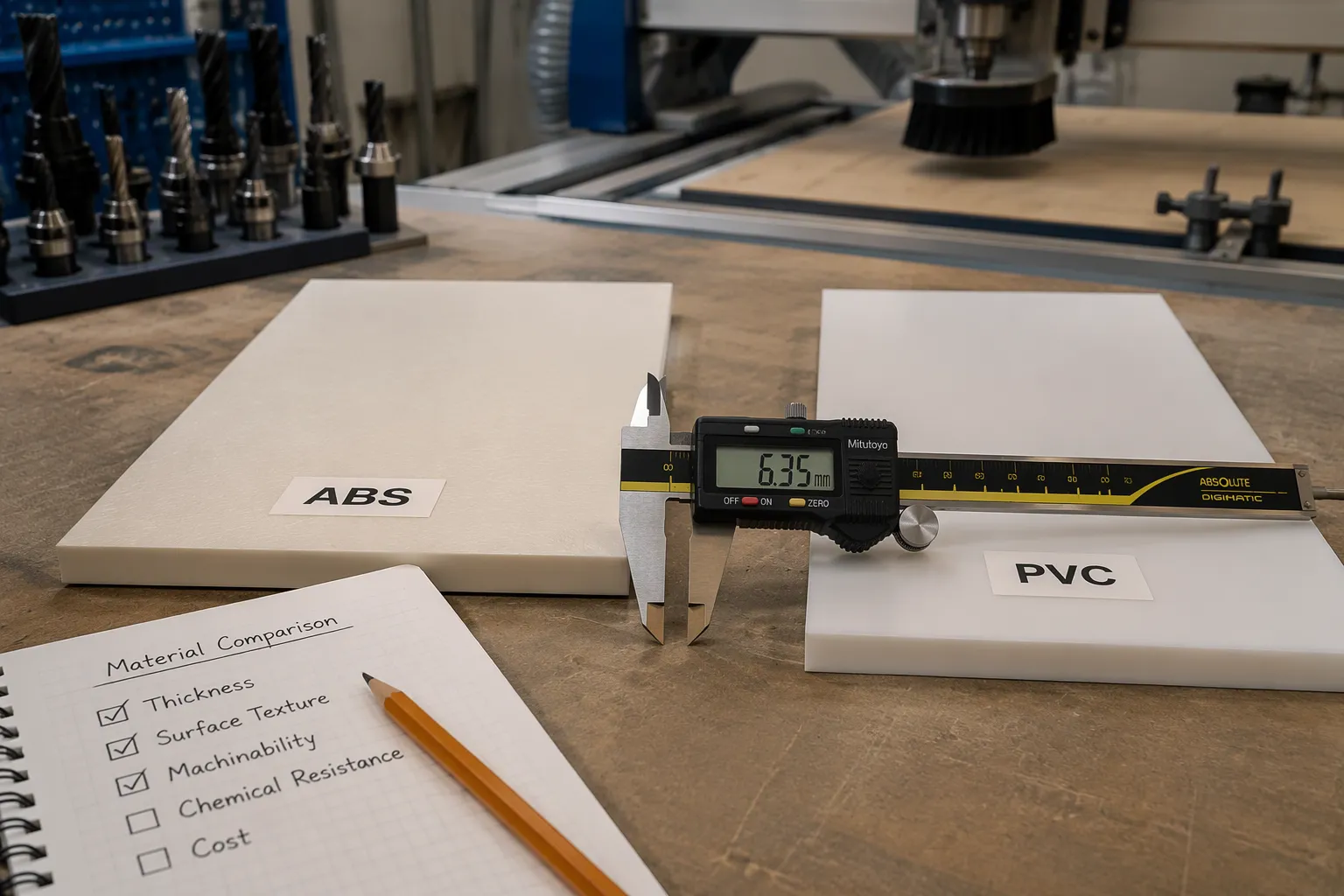
Neither material wins outright. Your abs vs pvc sheet decision comes down to five practical checks: the temperature range your part must survive, the impact loads it will face, the chemicals it will contact, the compliance rules it must meet, and your budget.
Technical performance, application fit, regulatory compliance, and cost drive every sound material selection. Weigh these four factors against your specific project before you order.
The stakes are real. A mismatched sheet can crack under load, fail a compliance test, or waste money on finishing steps you never needed. Compare abs and pvc sheets on these points, and you will choose the grade that fits your project the first time.
Key Takeaways
First, match your project's needs for temperature, impact, chemicals, and compliance.
ABS sheets are great at handling cold impacts and last a long time; PVC sheets stand up to chemicals and cost less.
Check the food-contact and fire ratings for your specific grade.
Compare the total cost, including making it and replacing it, not just the price of the sheet.
Get samples of both sheets and try them in your process before you decide.
ABS vs PVC Sheet: Technical Performance Compared
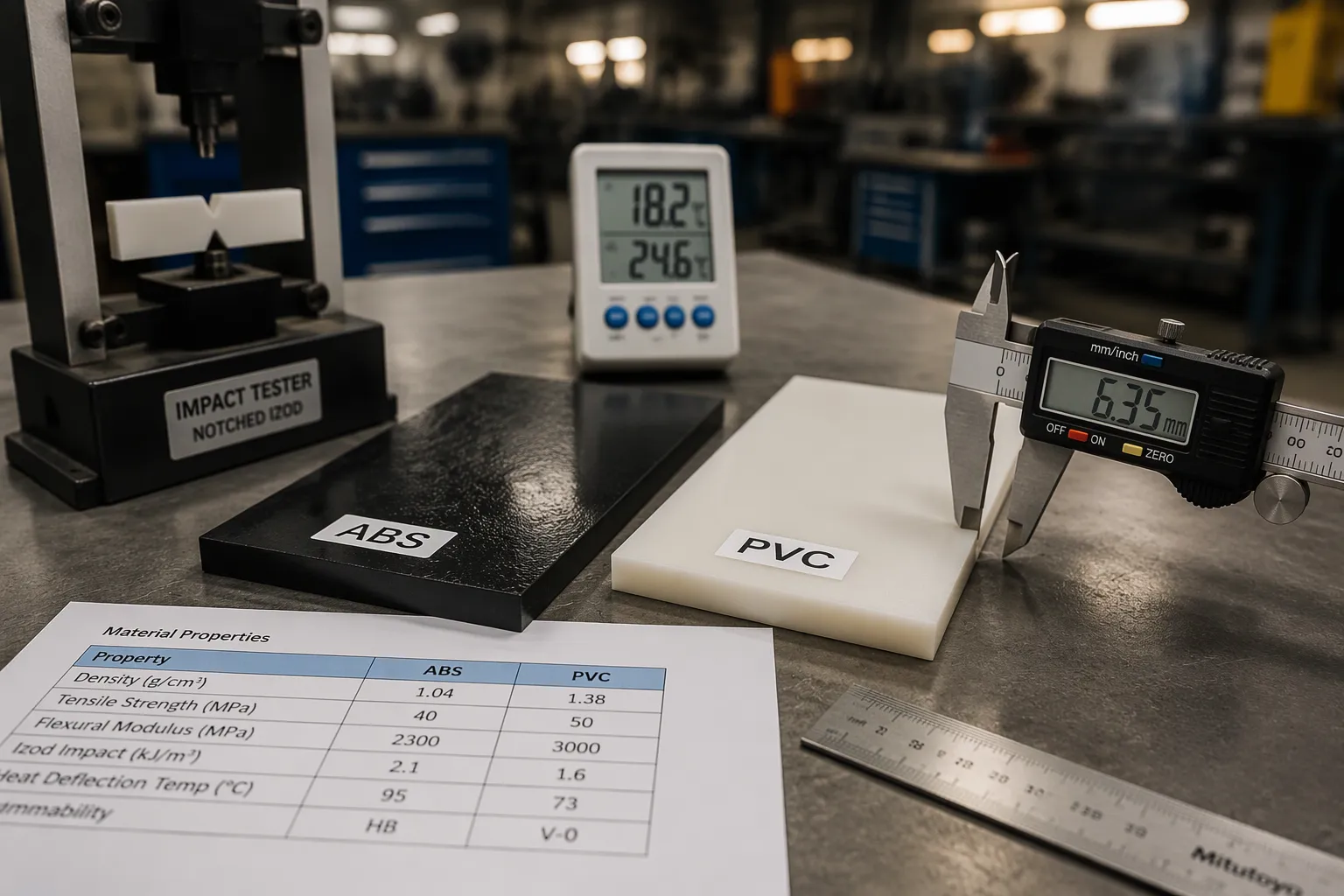
You can see the main differences in one table. Formech's technical newsletter lists specific gravity, impact behavior, and forming range for both materials.
Material | Specific gravity | Impact (Formech wording) | Vacuum-forming range | Pre-dry before forming? |
|---|---|---|---|---|
ABS | 1.08 | Impact resistant, stronger than HIPS | 150 to 180 °C (302 to 356 °F) | Yes |
PVC | 1.37 | Impact resistant | 140 to 190 °C (284 to 374 °F) | No |
Strength, Impact, and Temperature Tolerance
PVC sheets bend more easily and feel softer than ABS sheets. They hold up well against cleaning products, solvents, and UV light. ABS takes hits better and works better in cold weather. Most fabricators also find ABS a little easier to work with.
Cold weather is the key factor for many outdoor and cold-chain parts. ABS keeps its impact performance down to -40°C at 20 kJ/m² and above. Surfaces that need no spray and recyclability are two more things to look at that help you cut cost.
Xinhejiu's ABS SHEET gives you dimensional stability, dyeability, and UL94 V-0 fire retardancy. UV stabilizers and aging inhibitors make it last longer outdoors. Thickness runs from 0.5 to 12 mm.
When you need more heat and impact resistance, move up to Xinhejiu's PC/ABS SHEET. Notch impact reaches 18–45 kJ/m², with impact retention at -30°C. Heat distortion temperature is 100–130°C. The grade is halogen-free and RoHS/REACH compliant.
Standard ABS physical properties follow published ASTM methods. Typical values include tensile strength of 4,000 to 8,000 psi (ASTM D638) and Izod impact of 1.5 to 8.0 ft·lb/in (ASTM D256). Heat deflection at 264 psi is 170 to 190 °F (ASTM D648).
Cold still costs you impact strength. One maker's grades fall from 5.0 to 8.0 ft·lb/in notched Izod at 73 °F to 1.4 to 4.0 ft·lb/in at −20 °F.
Plan for 160 °F or less in continuous use. Heat deflection under a 264 psi load is 170 to 190 °F, and the glass transition is near 221 °F. ABS softens as it heats rather than melting at a set point.
Chemical Resistance and Machinability
This comparison with PVC sheets shows a clear split on chemistry. ABS resists acids, alkalis, and some solvents. PVC resists acids, salts, oils, and most corrosive substances, so it excels in harsh chemical and marine environments. The disadvantages of ABS compared to PVC appear with strong solvents.
Machining both thermoplastic sheets demands heat control. Plastics expand up to 20 times more than metals and lose heat slowly. Peck drilling removes swarf and prevents heat buildup. Band saws handle curves, and table saws suit straight cuts in thicker stock.
ABS mills easily. One fabricator runs 4.5 mm and 6 mm haircell ABS at about 16,000 RPM and 800 mm/min with a 1.2 mm depth of cut. The advantages of ABS over PVC here include paintability and heat forming. PVC sheets are cementable and take a smooth finish.
The composition and properties of each sheet drive these results. Acrylonitrile butadiene styrene brings toughness; polyvinyl chloride brings chemical resistance. Weigh both against your service conditions.
PVC vs ABS: Where Each Sheet Fits Best
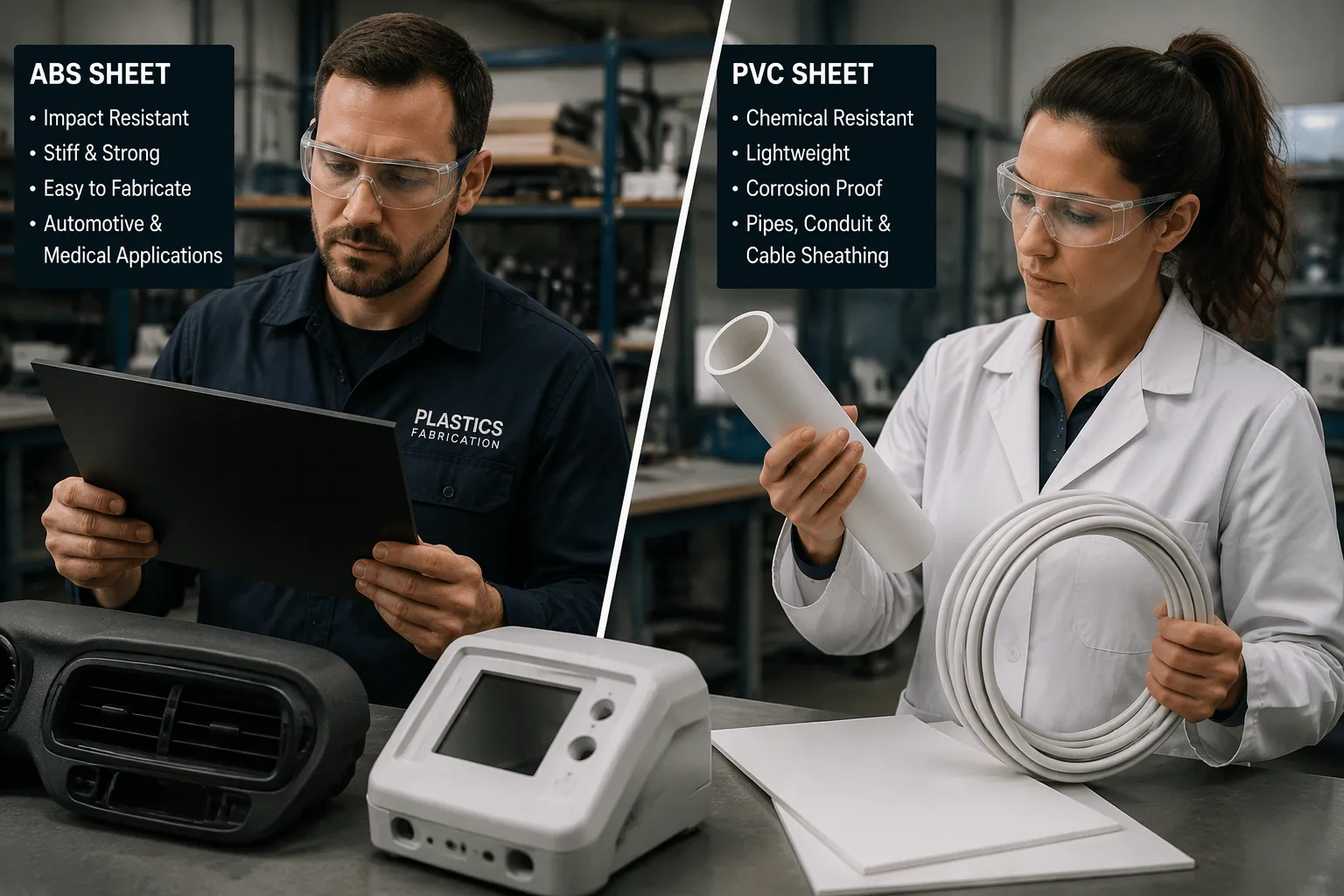
Application fit answers the abs vs pvc sheet question faster than any spec sheet. Each material has a natural home, and matching your part to that home saves rework later.
Common Uses for ABS Sheet
ABS covers a wide range of durable parts where looks matter. Automotive interiors use it for trim components, dashboards, and protective covers, where superior impact resistance and a clean finish both matter. Medical device housings and equipment covers rely on ABS because it stands up to sterilization while holding hygiene standards. Outdoor signage, point-of-purchase displays, retail fixtures, kiosks, and exhibit components all gain from the smooth surface and easy fabrication of these sheets. Industrial packaging and decorative veneer panels round out the list.
The advantages of abs sheets show up in secondary processing too. You can paint, print, and thermoform the material without special handling. Heat-resistant grades such as PC/ABS and HH ABS suit heavy truck fascia and interior components.
Outdoor work needs a warning. Standard ABS has a major weakness outdoors: long UV exposure makes it turn yellow, become brittle, and lose surface quality. Choose UV stabilized ABS for short service life or shaded sites, and step up to ASA when color stability matters over years.
Xinhejiu's Decorative Veneer solution builds on this strength. Multilayer constructions using ABS, ASA/ABS, PC/ABS, and PMMA/ABS deliver spray-free wood-grain, stone, and metallic finishes. Furniture, vehicle trim, and appliance panels gain a premium look without a painting step.
Common Uses for PVC Sheet
PVC sheets fit chemical-facing, flexible, and cost-sensitive work. Rigid PVC serves pipes, profiles, and construction formwork. Flexible PVC, softened with plasticizers, goes into cable sheathing, artificial leather, and flooring films. CPVC raises heat resistance to 90–95 °C for hot water pipes and chemical equipment. Anti-static PVC strip doors and partitions protect explosive atmospheres in mining, chemical sites, and laboratories, plus static-sensitive cleanrooms and data centers.
Chemical resistance is the headline property here. PVC resists hydrochloric acid at any concentration at room temperature, sulfuric acid below 90%, nitric acid at 50–60%, and caustic soda below 20%. It does not resist ketones or aromatics. These properties make pvc sheets a practical pick for fume hoods, tank linings, and lab partitions.
Hardness adjusts easily. You can specify soft PVC with plasticizers or rigid PVC without them. Good electrical insulation and self-extinguishing flame behavior extend the reach of pvc sheets into wire and cable sheathing. Strong processability covers extrusion, injection molding, calendaring, and thermoforming.
Cost sensitivity favors PVC in high-volume, simple-geometry parts. The material is often the budget-friendly choice for panels, ductwork, and protective barriers.
Neither material wins this section. Your intended application points to one family. Compare the composition and properties of both thermoplastic sheets against your service conditions, then confirm the grade. The advantages of abs sheets center on toughness and finish; pvc sheets center on chemistry and economy. Both paths lead to a sound part when you match material to job.
The Difference Between ABS and PVC Sheet in Compliance
Food Contact and Fire Ratings
Two compliance answers matter before you order: can the sheet touch food, and how does it act in a fire. Xinhejiu's ABS SHEET is non-toxic, tasteless, and safe for food contact.
Fire performance separates grades more than the base polymer does. Xinhejiu ABS and PC/ABS grades meet UL94 V-0. Blended products go further: an ABS/PVC blend sheet carries UL94 V-0, UL94-5V, and MVSS 302 ratings. Ask for the test report that matches your end product's standard.
Environmental and Recyclability Rules
Recyclability favors ABS in most shops. ABS can be recycled, and spray-free surfaces skip a paint step. Recycled ABS can cut raw material costs by about 15–40% against virgin resin. It still meets many electronics, automotive, and appliance requirements.
PC/ABS grades go further on chemistry. They are halogen-free, heavy-metal-free, and meet EU RoHS and REACH. RoHS limits lead, mercury, and chromium(VI) to under 0.1%, and cadmium to under 0.01%.
Flexible PVC formulations can be 100% recyclable and RoHS compliant, and REACH-compliant grades are available. Recyclability depends on formulation and sorting, so check the grade, not the material family.
Read the paperwork for abs vs pvc sheet orders the same way. The pvc vs abs split is clearest in documentation: the difference between abs and pvc sheet sits in the certificates, not the resin alone. Both abs and pvc sheets arrive with test reports. Request pvc sheets with plasticizer declarations, and specify pvc sheets with grade-specific food or fire clearance. Keep both sheets on file.
Acrylonitrile butadiene styrene gives ABS its toughness; polyvinyl chloride gives PVC its chemical resistance. Those composition and properties differences drive the compliance gap. Check physical properties on the datasheet, match those properties to your end use, and confirm the properties in writing. Ask whether the pvc sheets you shortlist carry the same ratings as the sheets you tested. Store the sheets with their certificates. Order samples of both sheets early.
ABS and PVC Sheet Cost: Material vs Fabrication
Comparing Sheet and Processing Costs
PVC often has the lower price tag. Buyers on a budget pick pvc sheets for panels, ductwork, and simple barriers. ABS pipe and sheet can cost more up front. That gap gets smaller once you add finishing and replacement costs. PVC installation may also need priming, which adds time and money to every joint.
Your processing choices change the total more than the resin price does. Xinhejiu's custom sizes and color matching cut machining scrap on abs and pvc sheets. Spray-free decorative surfaces skip the painting step completely. Factory-direct pricing and free sample books let you check both families before you buy.
When Paying More Up Front Pays Off
Higher-priced grades earn back their extra cost through longer service life. ABS has superior impact resistance, so parts survive drops and cold-weather handling that would crack cheaper stock. Fewer replacements mean lower lifetime spending. PC/ABS grades add heat resistance and UL94 V-0 ratings, which cut rework and compliance testing costs.
Weigh material price against fabrication time, finishing steps, compliance testing, and service life. A cheap sheet that needs priming, painting, and frequent replacement rarely stays cheap. Run the numbers on the full process before you order.
Match temperature, impact, chemical, and compliance needs first. Let cost break the tie.
The abs vs pvc sheet call rarely depends on price alone. Compare pvc vs abs on total cost, and the cheaper sheet often loses. Order samples of both sheets, test them in your process, and let the results decide.
First, match your needs for temperature, impact, chemicals, and compliance. Then let cost decide between them. This material selection guide keeps your abs vs pvc choice practical.
Check these things before you order: the temperature your part will face, impact including cold, chemical contact, food-contact and fire ratings, recycling goals, and budget.
Parts that face cold and heavy impact point to abs sheets. Work with chemicals, flexible needs, or a tight budget points to pvc sheets. Food-contact and fire-rated jobs need certified abs and pvc sheets. Compare abs sheets and pvc sheets on total cost. Neither family is the better material in every case. Order samples of both sheets, test them, and let the results guide your material selection.
FAQ
These quick answers cover the questions buyers ask most about ABS sheets and PVC sheets. Each answer points you to the checks that matter: temperature, impact, chemistry, compliance, and cost. Use these sheets of guidance to shortlist grades, then confirm details on the datasheet.
Can ABS sheets stay outdoors long term?
Standard ABS sheets yellow under long UV exposure. Choose UV-stabilized ABS sheets for shaded sites or short service life. Step up to ASA when color stability matters over years. Xinhejiu's ABS sheets run 0.5 to 12 mm thick, and these sheets suit signage and outdoor housings.
Which sheets handle cold impact better, PVC or ABS?
ABS sheets win. ABS sheets hold impact performance down to -40°C at 20 kJ/m² and above. PVC sheets grow brittle in cold. For extreme demands, PC/ABS sheets keep impact retention at -30°C. Match your lowest service temperature before you order either family of sheets.
Do ABS sheets and PVC sheets meet fire and food rules?
Not automatically. Xinhejiu's ABS sheets are non-toxic, tasteless, and food-contact safe. ABS sheets and PC/ABS grades meet UL94 V-0. PVC sheets depend on formulation, so request grade-specific certificates. Ask for the test report that matches your end product, and keep those sheets on file.
How do I compare pvc vs abs on total cost?
PVC sheets usually carry the lower price tag. ABS sheets cost more up front but resist impact better, so you replace ABS parts less often. Custom sizes and spray-free surfaces cut scrap on both sheets and skip painting. Weigh material price against fabrication time, finishing steps, and service life for these sheets.
What should I check before ordering samples of both sheets?
Run six checks: service temperature, impact exposure including cold, chemical contact, food and fire ratings, recycling goals, and budget. Order samples of ABS sheets and PVC sheets, then test both in your process. Both ABS and PVC sheets ship with test reports. Let results decide, not the datasheet alone.
Neither family wins every job. Cold impact favors ABS sheets. Chemical contact and tight budgets favor PVC sheets. Certified ABS sheets and PVC sheets cover food and fire work. Compare both ABS and PVC sheets on total cost, order samples, and let your process decide.