


Why Do Composite Plastic Sheets Crack During Deep Drawing
 Oct 19, 2026|
 View:
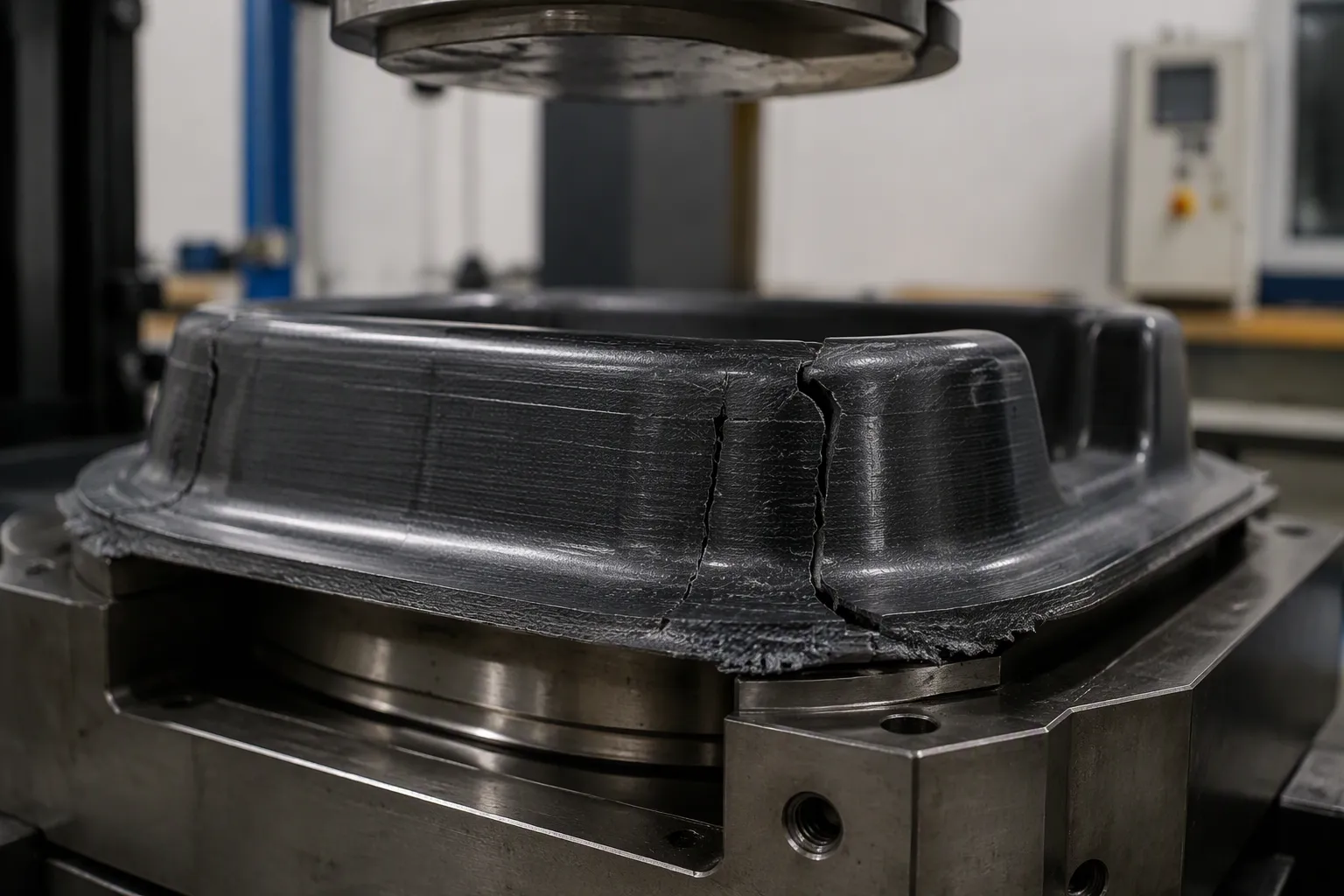
Cracking in composite plastic sheet deep drawing happens when pulling strain builds up in one area and goes beyond what the material can handle. Four forces cause this: material properties, process settings, tooling design, and environmental conditions.
Failure rarely has just one cause. Limited stretchiness interacts with too much process stress, poor friction control that blocks material flow, or bad tooling shape. A sheet that forms well under one set of conditions can tear under another.
Each factor below is explained by how it works and practical ways to reduce it. Technical and procurement readers can use these explanations to find crack-resistant sheet options and to ask suppliers about steady forming performance.
Key Takeaways
Cracking happens when strain builds up too much in one area. Choose a sheet with good toughness and aligned fibers to spread the strain.
Control temperature and forming speed to keep strain from concentrating. Warm, slow forming lets the material flow and reduces cracking risk.
Balance blank-holder force and die radius to allow smooth material flow. Too much force or a sharp die blocks flow and causes tears.
Dry sheets before forming to prevent steam bubbles. Store sheets in a steady, warm place to keep them flexible.
Fix all factors together for the best results. Material, process, tooling, and environment work as a system to prevent cracks.
Material Properties and Cracking Risks
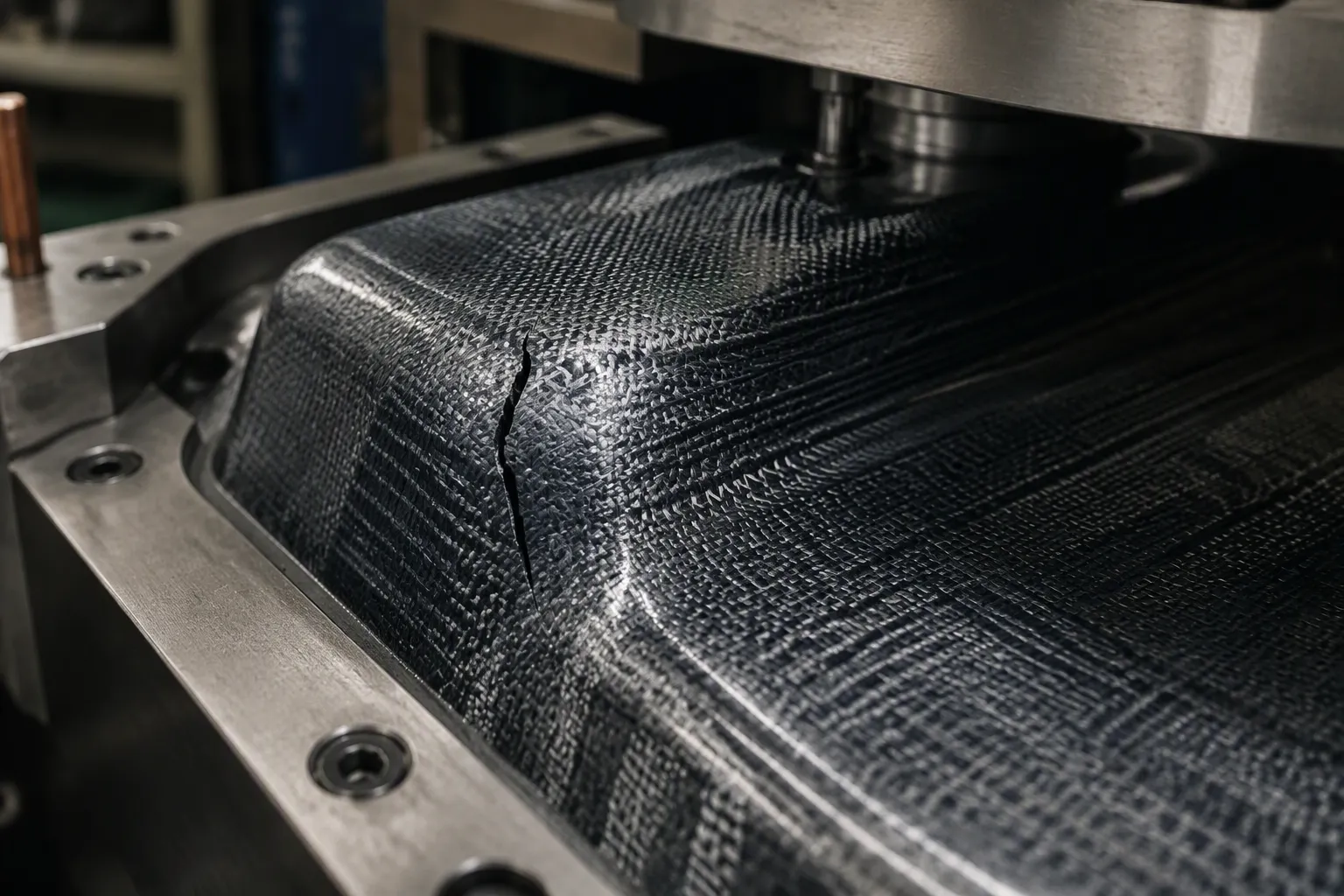
The sheet itself sets the first limit on how far a part can be formed. Two material traits matter most in a composite plastic sheet: how the reinforcement is arranged, and how tough the matrix is under load. Both traits decide where stress builds up and whether the part survives the press. Neither trait acts alone. They interact with process settings and tooling, which later sections cover.
Fiber Orientation and Anisotropy
Reinforcement fibers do not flow equally in every direction. They line up with the machine direction and the cross direction during sheet production. This lining up creates anisotropy, meaning the sheet acts differently along the warp and weft than it does on other radial lines. During deep drawing, the material is pulled radially outward from the blank center. The weft and warp lines resist that pull and end up shorter than the surrounding radial lines. Strain then builds up along those shorter lines. Once local strain passes the forming limit, a crack starts. A part can look fine on the press and still split at the corners, because the weak direction was never given enough material flow. The effect grows with draw depth. Shallow draws hide the problem, and deep draws show it. The mismatch is not a defect in the sheet. It is a natural result of how fibers settle during extrusion. Thin sheets show the effect sooner than thick ones, because there is less material to spread the load. Designers can lower this risk by lining up the blank so the strongest direction carries the highest stretch. They should also check the draw ratio against the sheet's directional data before cutting tools. A simple trial with a marked grid on the blank shows which lines shorten first and where cracking is likely to begin.
Matrix Toughness and Impact Strength
The matrix holds the reinforcement together and moves load between fibers. A brittle matrix cannot stretch far under high tensile stress. It reaches its breaking point early, and the crack runs through the part instead of blunting. Higher reinforcement content raises stiffness but usually lowers ductility, so the balance between the two decides the failure mode. Tough matrices soak up energy and slow crack growth, which widens the processing window. Reinforcement content also changes how the sheet responds to warm forming. A heavily filled grade may need a higher temperature to reach the same ductility as a lightly filled one. Impact modifiers in the compound can raise toughness, and the sheet supplier's data sheet should state the test temperature for any impact figure. A grade that passes a room-temperature impact test may still crack in a cold plant. Material selection should therefore weigh impact strength and elongation alongside stiffness, not stiffness alone. A sheet with modest stiffness but high toughness often forms deeper than a stiffer, more brittle grade.
Xinhejiu's PC/ABS Sheet shows this balance. Its notch impact strength of 18–45 kJ/m² resists brittle fracture even at -30℃, and its tensile strength of 50–70 MPa gives structural hardness without sacrificing toughness. The grade comes in thicknesses from 0.5 mm to 12 mm, which covers most forming needs. That combination makes it a strong candidate for demanding forming runs where wall thickness must stay uniform and cracking risks must stay low.
Process Parameters in Deep Drawing
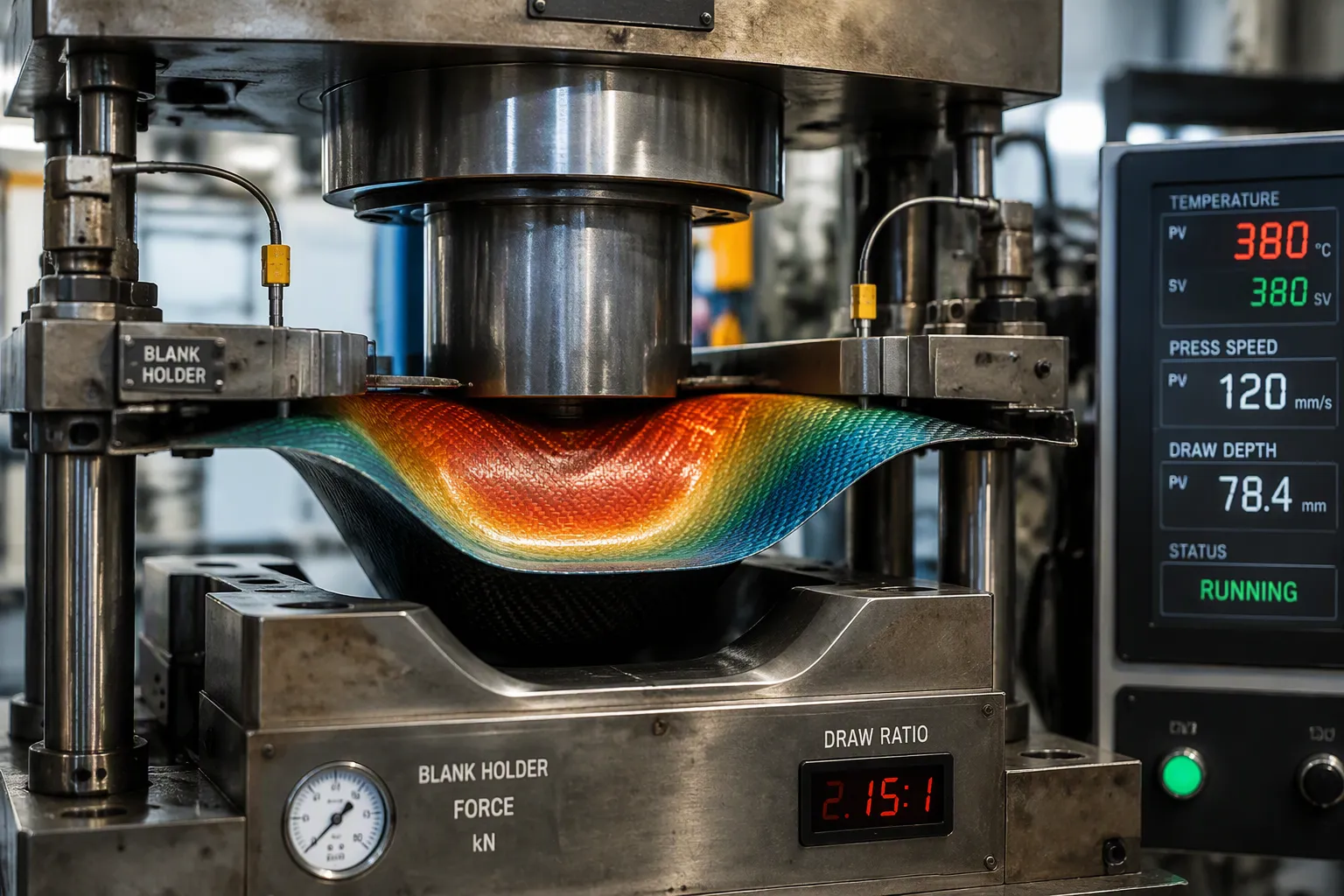
Choosing the right material sets the highest level of formability. Process settings decide whether a given sheet reaches that level or fails well below it. Temperature, speed, hold-down pressure, draw ratio, and friction all change the strain pattern inside the blank. Small changes in any one of them can move a part from clean forming to a split corner.
Temperature and Forming Speed
Warm deep drawing raises the sheet temperature to soften the matrix and lower the forming load. A softer matrix flows more easily around the punch, so strain spreads over a wider area instead of building up at one edge. The result is a lower cracking risk and a more even part. Temperature must stay inside a window. Too low, and the sheet acts like a brittle solid. Too high, and the material sags, sticks to tooling, or loses dimensional control after forming.
Forming speed matters just as much. A fast punch stroke pushes strain into a narrow band near the punch nose. The material has no time to spread out, and local strain climbs past the limit. Slower strokes give the polymer time to relax and let material flow reach the corners during forming. The right speed depends on sheet thickness and draw depth. Thin sheets and deep draws need gentler speeds, because there is less material to carry the load and more distance for strain to build up.
Blank Holder Force and Draw Ratio
Blank-holder force controls how easily the flange slides inward. Too much pressure clamps the flange and blocks material flow. The punch then stretches the wall instead of pulling new material in, and the material tears near the base. Too little pressure lets the flange buckle, and the risk of wrinkling or tearing rises on both counts. The correct force sits in a narrow band that holds the flange flat while still letting it slide.
Draw ratio sets the demand side of the balance. A ratio that is too aggressive for the grade forces more material into the cavity than the flange can supply, and cracking follows. Friction management belongs in the same discussion. Too much friction at the die radius or blank holder acts like extra hold-down force and starves the cavity of material flow. Lubricant choice, coating condition, and surface finish all change the friction level, so they should be treated as process variables, not afterthoughts.
Xinhejiu's Sanitary Grade PMMA/ABS Sheet is engineered for this balance. It supports deep-draw thermoforming of large bathtubs without wall thinning, micro-cracking, or corner bursting, backed by a notched impact strength of 8–12 kJ/m².
Tooling Design and Wall Thinning
Die Radius, Clearance, and Surface Finish
A die entry radius that is too small blocks material flow. The blank cannot slide over a sharp edge, so the punch stretches the wall instead of pulling new material inward. Stretch builds up at the transition zone, and fracturing follows once local strain passes the limit. A generous draw radius spreads the bend over a longer arc and keeps material flow steady during forming. Corner radii need the same attention. Tight corners on a rectangular part act like small die radii on every side, and they often split first. The safe radius scales with sheet thickness and draw depth. Deep draws in a thin composite plastic sheet need a larger radius than shallow draws in a thick one, and the tool drawing should state the minimum value for each grade. Cracking at the die lip is usually a radius problem, not a material problem.
Clearance and surface finish shape friction and strain distribution across the part. Too much clearance lets the wall buckle. Too little clearance scrapes the sheet and raises friction, which starves the cavity of material flow. A polished die surface lowers friction and evens out strain distribution.
Punch Geometry and Friction Control
Punch-end thinning is a major defect in deep drawing. The punch nose forces the wall to stretch over a small contact area, and local thinning appears before any visible crack. Localized necking then turns into tearing or too much thinning at the base. Punch geometry drives this outcome. A rounded nose spreads the load, while a flat nose with sharp edges concentrates it. Lubrication changes how much wall thinning occurs, because a dry interface locks the sheet against the punch and pulls the wall thin. Poor material flow control here produces the classic rupture during forming at the punch corner. Wall thickness readings taken after forming show where the risk of fracturing sits. A part that survives the press can still fail later. Strong deformation leaves leftover tensile stress, and secondary processing such as trimming, drilling, or assembly can release it as brittle cracks.
Environmental Factors and Prevention
Humidity and Moisture Absorption
Moisture changes how a sheet acts before it even gets to the press. Plastic grades soak up water from humid air while in storage, and that water turns into steam when the sheet is heated. Bubbles form on the surface and inside the sheet during thermoforming. Every bubble makes the sheet weaker and creates a spot where cracking can start. EN ISO 62 is the standard test for how much moisture solid plastics absorb when soaked or exposed to humid air, and it lets buyers compare batches. Absorbed water also makes the sheet change size and can pull out water-soluble parts, so the sheet may no longer meet its original spec.
Drying is the practical fix. Polycarbonate grades usually dry at 120–130°C in a hot-air oven, and the time depends on sheet thickness: 4–6 hours for 1.5–3 mm, 8–10 hours for 4–6 mm, and 12–16 hours for 7–12 mm. Form the blank within 30 minutes after drying, and dry it again if it sits out for more than an hour. Dirt makes the problem worse. Fillers, stearates, and other powders soak up moisture and cause uneven thickening and curing, which makes bubbles. Compressed air used to clean flash carries water vapor and oil splashes, so check it during the whole run.
Ambient Temperature and Storage
Cold sheets lose their ability to stretch. A blank stored in a cold plant acts like a stiffer grade on the press, and strain builds up sooner during deep drawing. Storage that changes from day to day is just as bad, because the first blank of a shift may form differently from the last. Warm the sheet to a steady temperature before forming, and keep storage areas dry and consistent.
Prevention Summary
Good results come from matching the material grade to the draw depth, controlling temperature and forming speed, balancing blank-holder force, and improving die radius and clearance. Moisture control belongs on the same list. Dry the sheet to spec, form it right away, and keep vacuum on until the surface drops below 60°C. These steps protect formability, limit thinning, and keep wall thickness even. They also help material flow stay steady during forming, since dry, warm sheet slides the same way each time and needs less force to fill the cavity. Good material flow during forming lowers local strain, and that is the best way to prevent cracks.
Cracking in composite plastic sheet deep drawing seldom comes from just one cause. Material limits, process stress, tooling shape, and shop-floor conditions all affect each other. Fixing only one of them often just moves the failure to another spot. Steady results come from tuning fiber orientation, matrix toughness, temperature, speed, blank-holder force, die design, and moisture control as one system. That combined approach keeps draw depth within the grade's limit and keeps wall thickness even, with less thinning and steadier material flow.
Supplier evaluation should therefore weigh toughness data and steady forming performance, not price alone. Xinhejiu's PC/ABS and PMMA/ABS sheet families offer high impact strength and deep-draw formability for crack-sensitive applications.
FAQ
What causes cracking in composite plastic sheet deep drawing?
Cracking starts when local tensile strain goes past the sheet's forming limit. Anisotropy, a brittle matrix, fast punch speed, tight die radius, or too much blank-holder force can each push strain past that limit. Most failures combine two or more of these causes.
Which sheet grade resists cracking best?
Match the grade to the draw depth and load. Xinhejiu's PC/ABS Sheet offers 18–45 kJ/m² notch impact strength and 50–70 MPa tensile strength, with brittle-fracture resistance down to -30℃. Its PMMA/ABS Sheet delivers 8–12 kJ/m² for deep-draw sanitary ware.
How do temperature and speed affect deep drawing?
Warm forming softens the matrix and lowers the forming load. Slow punch strokes let strain spread out instead of building up at the punch nose. Keep both inside the grade's window, since overheating causes sagging and too much speed causes tearing.
Why does moisture matter before forming?
Absorbed water turns to steam during heating and makes bubbles that weaken the sheet. Dry polycarbonate grades at 120–130°C, then form within 30 minutes. EN ISO 62 testing helps buyers compare moisture absorption between batches.
How should buyers evaluate crack-resistant suppliers?
Ask for impact strength data with test temperatures, elongation figures, and forming trials on your part geometry. Steady material flow during forming and consistent batch quality matter more than a single headline number. Request samples before production release.